Thank you for being here, it really means a lot
I am so glad many of you already joined me for the ride: thank you for the trust.
See you in person?
Atypi is coming to Stanford: if you are attending please come and say hi! Report from the conference on the next issue.
A beginning: Pochi ma buoni [a few good ones]
Let’s start with something very important: everything you’ll read I've written myself1, word for word. It's the bare minimum: if I didn't spend time to write it, why would you even bother reading it? Sentences may sometimes be clunky—bear with me, English is not my native language—but good or bad they will be mine. Please don’t be fooled by em-dashes: that is not generative AI, just care for good typesetting. I love em-dashes so much, I refuse to give them up. Love en-dashes too—the neglected one that means «from–to»—and of course I sprinkle «guillemets» all over my text.
The famous quote by French Surrealist André Breton «One publishes to find comrades» has been sitting on my desk for at least two years, annotated quickly on a post-it. I was listening to something and that sentence resonated deeply. Finding community through publishing was what I used to do when, still in college in Milan, I started my studio—and its blog, now lost. What at the time seemed like an obvious move—of course in 2006 you started a blog—put me in contact with a wide range of interesting people, and most importantly it was a lot of fun to write.
Like many of you, I slowly moved my connections to social media. In hindsight that was a bad choice that only worked in the very beginning, if ever. Then old-Twitter was murdered, Instagram is still there but it's more awful by the day, Bluesky is too US-centric. The only joy is the type community on Mastodon (follow me there)
I simply want to try another way to keep in touch. IG is still my primary way of being in contact with fellow designers and friends, and I hate it. The algorithm is unpredictable and frustrating. Who will read this? Should I even bother sharing it? What made me shadow-banned this time? Moreover you can’t save or search, which is a shame because so many people make great content there that it’s just impossible to find.
We say in Italian «pochi ma buoni»: a few good ones. We do some things as means to ends and other things as ends in themselves. Those are the ones that matter. I strongly believe it's the right time for small well-crafted things, created by humans for other humans, with love and care.
Every few weeks you will find in your inbox:
A main topic
«Something I’d love to chat about if we got together for a drink at a conference or an exhibit somewhere». Could be a deep dive into a theme—like the issue on analog and digital archives that I am currently putting together—or something that has been on my mind for a while, like how to keep being creative beyond client work.A list of interesting work by artists and designers
Art is the best present to give or share with someone, and we should support each other.Visual notes
What caught my eye on my everyday life.I have to find a project for this typeface
An ongoing list of mine, for the love of type.What I am reading/listening/watching
Links with comments, inspired by my friend Kevin who sometimes shares his list with friends.
Forget-me-not
Community has always been the most important aspect of my professional—and personal—life. I simply am happier when I have friends around. The type community is the unexpected gift I got from my academic studies, so I want to start this first issue with a little tribute to two people that were very influential when my love for typography started, but that sadly are no longer with us.
In April 2025 I got the news that Lucio Passerini (1954–2025) passed away. He was a typographer and printer, a kind gentleman, a generous teacher, and had a fantastic sense of humor. He was one of the instructors—together with James Clough—of the letterpress and typography evening course [Corso di design tipografico] I took at CFP Bauer in Milan while still in college. It marked the beginning of my love for type and historic research—both still going strong. At the time he was so kind as to review the design of my dissertation book, and his comments made it so much better.
He curated the Italian editions of many important texts on typography, among others the classic «The Elements of Typographic Style» [Gli elementi dello stile tipografico] by Robert Bringhurst. He will be missed by letterpress printers and typographers worldwide.
You can still visit the website of Il Buon Tempo, his private press.
An article from Paul Shaw with very sweet photos of his workshop at Tipoteca
His interview for Letterpress Workers [text in Eng]
A video interview [Ita] where you can hear him talking about his private press

Lucio Passerini, Image from Letterpress Workers
A few months later James Mosley (1935–2025) passed too. Gerard Unger used to call him «the greatest historian of type and typography of all time». He was librarian at the St Bride Library in London, and taught at the Department of Typography & Graphic Communication at the University of Reading. He spoke Italian and loved the country, together with France and obviously Britain. My research on 19th century Italian type started with a document he compiled, that he generously shared with me and Emanuela Conidi. I’ll be forever grateful to him for having believed in two young students who didn’t know much but were very excited about researching old type. I wrote a post about him on my website last year, in the likely case you missed it. Lots of links collected there.
The image for this newsletter is a Caslon Old Face punch from James Mosley’s blog, still on-line for you to read.

My very worn out copy of his «The nymph and the grot»
I have to find a project for this typeface: an ongoing list
Let’s start with Lofi Forest by Kilotype: pixels meet engraved lettershapes. All images come from the pdf specimen (download here)


Very well executed shadows

Solid version, pixelated edges, to create a layered composition

The two combined. Very cool.
Interesting things I came across this month


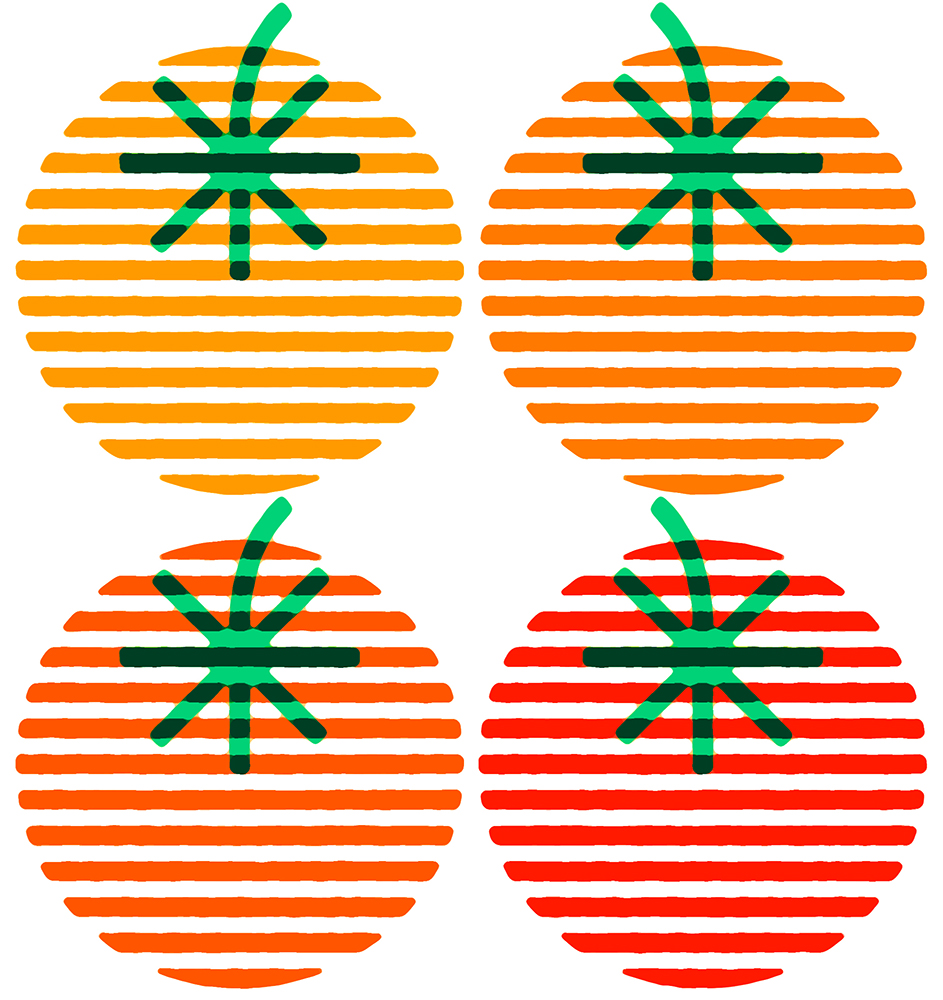
I fell in love with the work of Italian artist Giacomo Bagnara, in particular his «Lines and dots» selection. The little imperfections of the patterns give the minimal illustrations so much character and warmth. A few variations and a restrained color palette are all you need. Would definitely put a few on my kitchen wall.

Photo of a detail from Culee Dam series from Z. Vanessa Helder
I have never gone twice to a museum to see the same show, but I did for the precisionist watercolors of Z. Vanessa Helder (1904–1968), currently on display at SAM Seattle Art Museum as part of «Beyond Mysticism: The Modern Northwest». Every first Thursday of the month the museum is free and open late, so I went twice in a row. The work on display—a loan from the Northwest Museum of Arts and Culture—focuses on the series of watercolors about the construction of the Grand Coulee Dam. They are eerie and dynamic, the composition never straight. You can easily recognize the bare landscape of Eastern Washington. Such a talented woman, and what a cool signature!
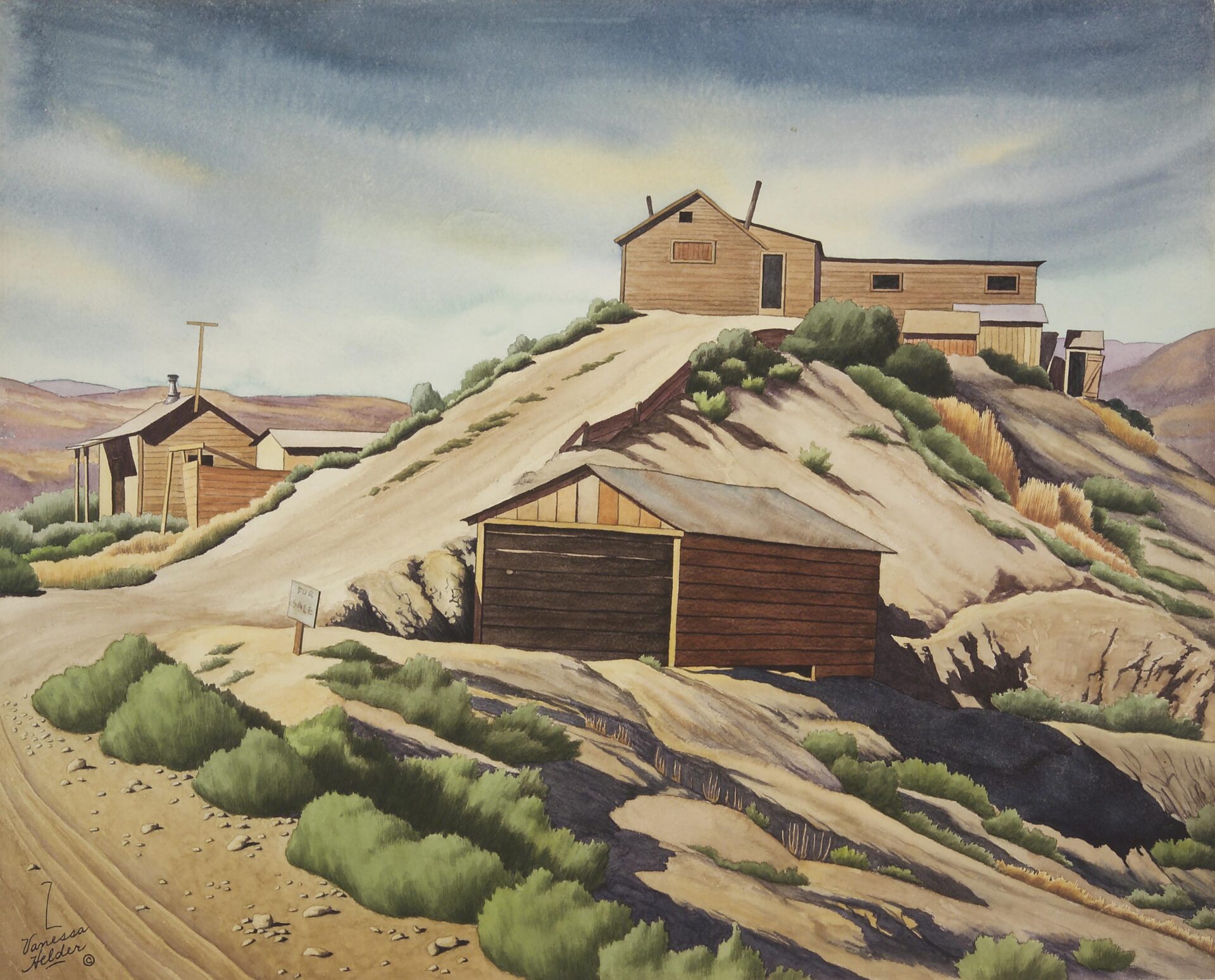
Image from Cascadia Art Museum
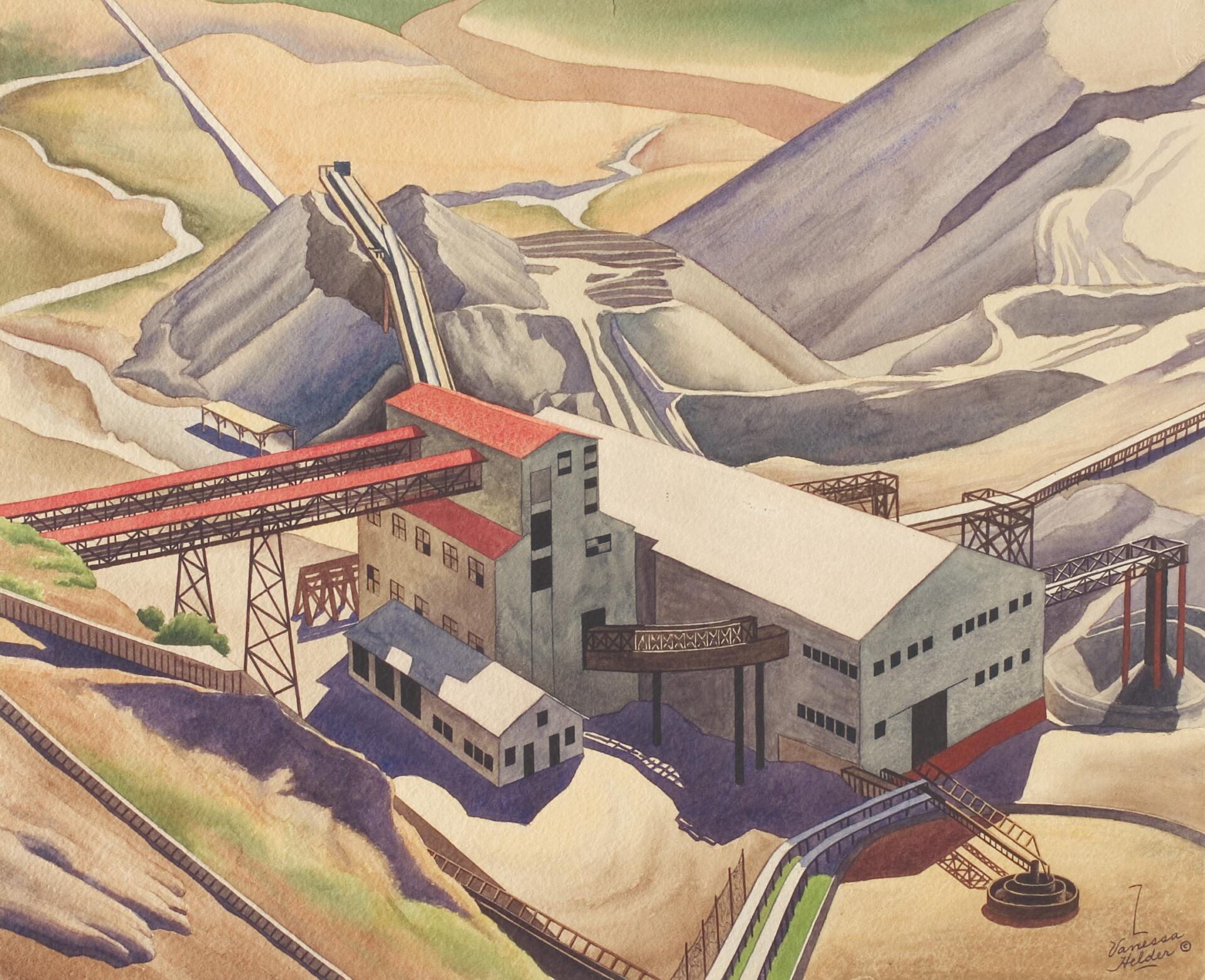
Image from Cascadia Art Museum

Photo of a detail from her Culee Dam series

Visual notes

Seattle sidewalk

Seattle sidewalk II

Who doesn’t like old maps

Old tiles are the best

My first attempt at pottery. Needs to be fired still. It was a lot of fun

Lucky shot

Neon sign owned by collector John Bennett on the side of a building at 6014 12th Avenue South in Seattle's Georgetown neighborhood.

Rosalie Gale’s tufted strawberries at Seattle Art Museum’s shop. Yay to local artists

Colors of a project being installed in the summer. Metallics!

Studio e gallery is my favorite in Seattle. Last month show by Gabriel Stromberg.
All photos are available in higher res on my Flickr album.
What I am reading/listening to
AI Snake Oil: What Artificial Intelligence Can Do, What It Can’t, and How to Tell the Difference.
Halfway through, I am learning a lot from this book (though I don’t always agree, but who does). I am trying to understand more about LLMs, generative vs predictive AI, what is legit and what is hype. We’ll get back to this topic multiple times in the future, I suspect.
The AI Con: How to Fight Big Tech’s Hype and Create the Future We Want.
Glad I read this first before the one above: interesting first chapter, I appreciated their overview of the history of work automation. Some readers complained about the snarky tone, I personally liked it. It's sometimes a bit too academic (very detailed). If you are interested but don’t want to commit to a whole book, they have a podcast (same link as above) and gave many interviews. Review from The Guardian.
Una questione privata / A private matter Beppe Fenoglio
The Path to the Nest of Spiders (Il sentiero dei nidi di ragno) Italo Calvino.
I have decided it's time to read/re-read Calvino and other Italian writers that experienced the rise of Fascism, WWII, and the post-war years. They were mandatory reading in high school in Italy, but it's very different to read them today, as an adult and with the current political climate. They are great books and I am so glad I am doing this.
—
That is all for now. Thank you for your time! Comments are welcome, I am always happy to hear from you.
A presto, talk soon
Marta
On publie pour trouver des camarades ! / One publishes to find comrades! / Pubblichiamo per trovare compagne e compagni!
1 Thank you to the dear friends that read a final draft and suggested edits. You are the best and I am very lucky.